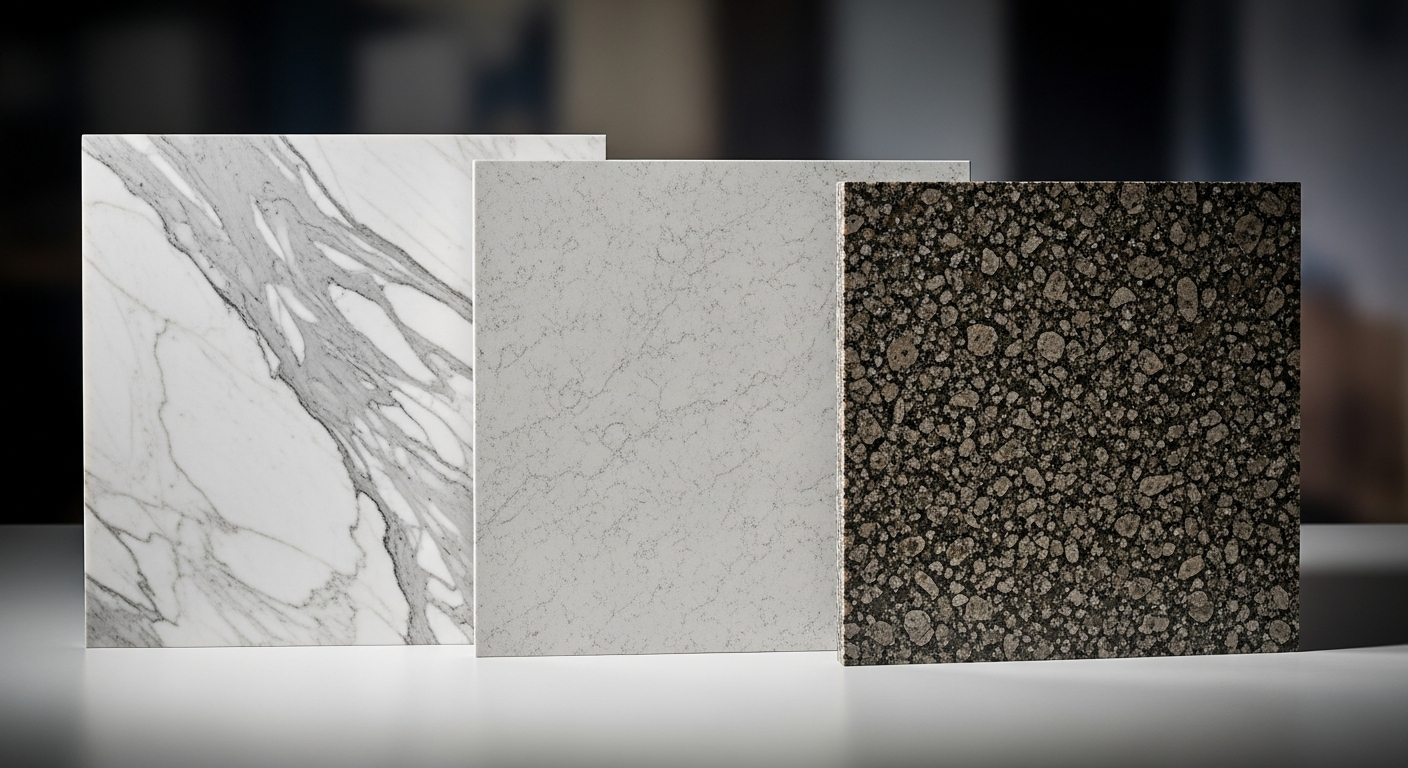
Countertop selection is one of the most consequential material decisions in any kitchen or bathroom renovation. You will interact with your countertops every single day for the next 15 to 25 years. The decision deserves more analysis than the way a sample looks under showroom lighting.
This guide evaluates every major countertop material on the dimensions that matter over time: durability, maintenance requirements, heat and stain resistance, appearance, and cost. Understanding the trade-offs between materials — not just their visual appeal — is what allows homeowners to choose a surface they will be satisfied with a decade from now.
What Makes a Countertop Material Perform Well?
Before evaluating specific materials, it helps to have a framework. Countertop performance has five primary dimensions: scratch resistance (how well it holds up to daily use without marking), heat resistance (whether hot pots and pans damage the surface), stain resistance (how the material responds to acids, oils, and food pigments), maintenance requirements (sealing frequency, permitted cleaners, and repair options), and long-term appearance retention (whether the material looks the same at year 15 as it did at year one).
No material scores perfectly on all five dimensions. Every countertop choice involves trade-offs. The most important skill in countertop selection is being honest about how your kitchen is actually used — not how you imagine it should be used — and choosing a material that matches those real conditions.
Quartz (Engineered Stone)
Quartz countertops are engineered products: approximately 93 to 95 percent crushed natural quartz aggregate bound with polymer resins. This manufacturing process produces a non-porous surface that never requires sealing, resists staining from virtually all common household substances, and can replicate the appearance of natural stone with remarkable fidelity.
Quartz is scratch-resistant under normal use but is not scratch-proof — repeated abrasion from gritty substances will mark the surface over time. It is heat-resistant to a point but is vulnerable to thermal shock from very high heat: placing a hot cast iron pan directly from the oven onto a quartz surface can cause discoloration or cracking. Use trivets. Quartz is highly consistent in appearance (because it is manufactured), which means it does not have the natural variation of stone — a feature some homeowners value and others find less interesting.
Cost range: $70 to $150 per square foot installed. Quartz is the recommendation for households that prioritize low maintenance above all other considerations. It is also the most practical choice for bathroom vanity tops, where water exposure is constant and stone sealing is easy to forget.
Granite (Natural Stone)
Granite is an igneous natural stone quarried from formations worldwide. Every slab is unique in its pattern, color, and character — the natural variation that many homeowners find beautiful. Granite is hard, scratch-resistant, and heat-resistant. It is porous, however, which means it absorbs liquids at a microscopic level and requires periodic sealing (typically once a year for kitchen applications) to prevent staining.
The sealing requirement is the most common source of granite maintenance issues. A properly sealed granite countertop performs very well. A granite countertop where sealing has been deferred for several years may show staining, particularly from oils, wine, and acidic foods. Granite edges can chip at corners if struck; chips can typically be repaired by a stone professional.
Cost range: $60 to $130 per square foot installed, depending on slab origin, pattern rarity, and thickness. Granite remains an excellent choice for homeowners who want the character of natural stone at a lower cost than marble or quartzite, and who are willing to commit to periodic maintenance.
Marble and Quartzite
Marble is a metamorphic limestone prized for its white base color and dramatic veining. It is the most visually luxurious countertop material and the most demanding to maintain. Marble is soft relative to granite and quartz: it scratches and etches readily. Etching — the dulling of the stone's polished surface from contact with acidic substances — occurs within seconds of exposure to lemon juice, wine, tomato, or vinegar. This is not a staining issue (the stone is not absorbing the substance) — it is a chemical reaction between the acid and the calcium carbonate in the stone. The etching is permanent unless the stone is professionally re-polished.
Quartzite is a metamorphic stone that is frequently confused with quartz (they are completely different materials). Quartzite is a natural stone with the visual character of marble — soft whites and grays with dramatic veining — but significantly harder and more acid-resistant. It still requires sealing but is far more forgiving than marble under kitchen conditions. Quartzite is currently one of the most in-demand countertop materials in Westchester kitchen renovations for homeowners who want the look of marble without its vulnerability.
Cost range: Marble $80 to $200+ per square foot installed; Quartzite $100 to $250+ per square foot installed, depending on rarity of the slab.
Porcelain Slabs
Large-format porcelain slabs — typically 126 by 63 inches — are a relatively recent development in countertop materials. Porcelain is fired ceramic tile scaled up to countertop dimensions, and it shares many of tile's properties: it is non-porous, never requires sealing, resists heat, and is highly scratch and stain resistant. Porcelain slabs are available in marble-look, stone-look, concrete-look, and solid color designs, often at very high visual fidelity.
The primary limitation of porcelain countertops is brittleness. While the surface is extremely hard, porcelain can crack under sharp point impacts (a dropped cast-iron pan corner) or at thin-section areas. Porcelain is also more difficult to fabricate than stone — edge profiles and cutouts require specialized equipment and skilled installation. When installed correctly, porcelain countertops are extremely durable and among the lowest-maintenance options available.
Butcher Block and Wood
Butcher block countertops — made from glued strips of wood (typically maple, walnut, or oak) — bring warmth and natural material character to kitchen design that stone and engineered surfaces cannot replicate. They are particularly effective as island surfaces, used in conjunction with a stone perimeter countertop for contrast.
Wood countertops require more active maintenance than stone: they need periodic oiling (mineral oil or food-safe hardening oil), they scratch and dent under heavy use, and they swell and contract with humidity changes. Water allowed to sit on a wood surface without prompt wiping will damage the finish over time. Wood countertops adjacent to sinks require particularly careful installation and ongoing attention. For homeowners who enjoy the natural material and are willing to maintain it, butcher block delivers an aesthetic that no other material can match.
Laminate and Solid Surface
Laminate countertops (Formica and similar) have improved substantially in recent years. Current laminate products can mimic stone with convincing visual patterns, and they remain the most cost-effective countertop option. Laminate is not heat-resistant (hot pots will cause immediate damage), cannot be repaired when scratched or chipped, and has an exposed particleboard or MDF substrate that is vulnerable to water infiltration at seams and edges. For budget-focused renovations or secondary kitchens, laminate delivers acceptable performance at minimal cost.
Solid surface materials (Corian and similar) are acrylic or polyester resin products that offer seamless installation and the unique advantage of repairability: scratches can be sanded out by a professional, and integrated sinks eliminate the seam at the sink cutout. Solid surface is softer and less heat-resistant than stone, but its repairability and seamless installation make it an appropriate choice for bathroom vanities and laundry rooms.
How to Choose the Right Material for Your Household
The honest answer to 'which countertop is best?' is: the one that matches how your household actually operates. If you cook frequently, have children who will use the kitchen countertop as a work surface, and know you will not remember to oil stone once a year — choose quartz. If you bake regularly, appreciate natural material character, and are committed to re-sealing annually — granite or quartzite will reward you with beauty that engineered materials cannot replicate.
For bathroom vanity countertops: quartz or porcelain are almost always the best choices. Bathrooms see constant water exposure, and stone sealing is the maintenance task homeowners are most likely to defer. A non-porous surface eliminates the risk entirely.
Ready to Start Planning?
Talk to the Three Brothers Team
We've completed hundreds of kitchen and bathroom renovations across Westchester County since 1979. Visit our Chappaqua showroom or call to discuss your project.
Frequently Asked Questions
What is the most durable countertop material?
Quartzite and porcelain slab rank among the most durable natural and engineered options. Quartz engineered stone is extremely durable under normal household use. Granite performs very well when properly sealed. No material is completely indestructible — all surfaces can be damaged by extreme force, thermal shock, or prolonged neglect.
Do quartz countertops need to be sealed?
No. Quartz countertops are non-porous by their manufacturing process and never require sealing. This is one of the primary maintenance advantages quartz holds over natural stone.
What countertop is easiest to maintain?
Quartz is the easiest to maintain: it requires no sealing, cleans with soap and water, and resists staining from virtually all household substances. Porcelain slab is equally low-maintenance. Laminate is easy to clean but cannot be repaired when damaged.
Is marble a practical kitchen countertop?
Marble is beautiful but demanding in kitchen applications. It etches from acid exposure (any citrus, wine, vinegar, or tomato-based food), scratches more readily than granite, and requires sealing. Many homeowners choose marble knowing its maintenance requirements and embrace the way it patinas over time. For others, the maintenance is a source of ongoing frustration. Quartzite offers a similar visual character with significantly better durability.
How much do countertops cost in Westchester?
Installed costs in Westchester typically range from $40 to $80 per square foot for laminate, $60 to $130 for granite, $70 to $150 for quartz, $100 to $250+ for quartzite, and $80 to $200+ for marble. These ranges vary based on slab thickness, edge profile complexity, and number of cutouts for sinks and faucets.
Can countertops be repaired?
Chips in granite and marble can be repaired by a stone professional using color-matched epoxy. Quartz chips can be filled similarly but may not match perfectly. Solid surface (Corian) can be sanded and refinished by a professional. Laminate and porcelain cannot be repaired when chipped — the damaged section must be replaced.
What countertop material adds the most value to a home?
Natural stone countertops — granite, marble, and quartzite — and engineered quartz all consistently add value to home resale. Quartz is often cited by real estate professionals as the safest investment because of its broad appeal and low maintenance. Marble adds significant value in luxury home markets but may deter some buyers who are concerned about its maintenance.
What is the difference between quartz and quartzite?
Quartz (engineered stone) is a manufactured product made from crushed quartz aggregate and polymer resins. Quartzite is a natural metamorphic stone that resembles marble in appearance but is significantly harder. They sound similar but are completely different materials with different properties, maintenance requirements, and price points.