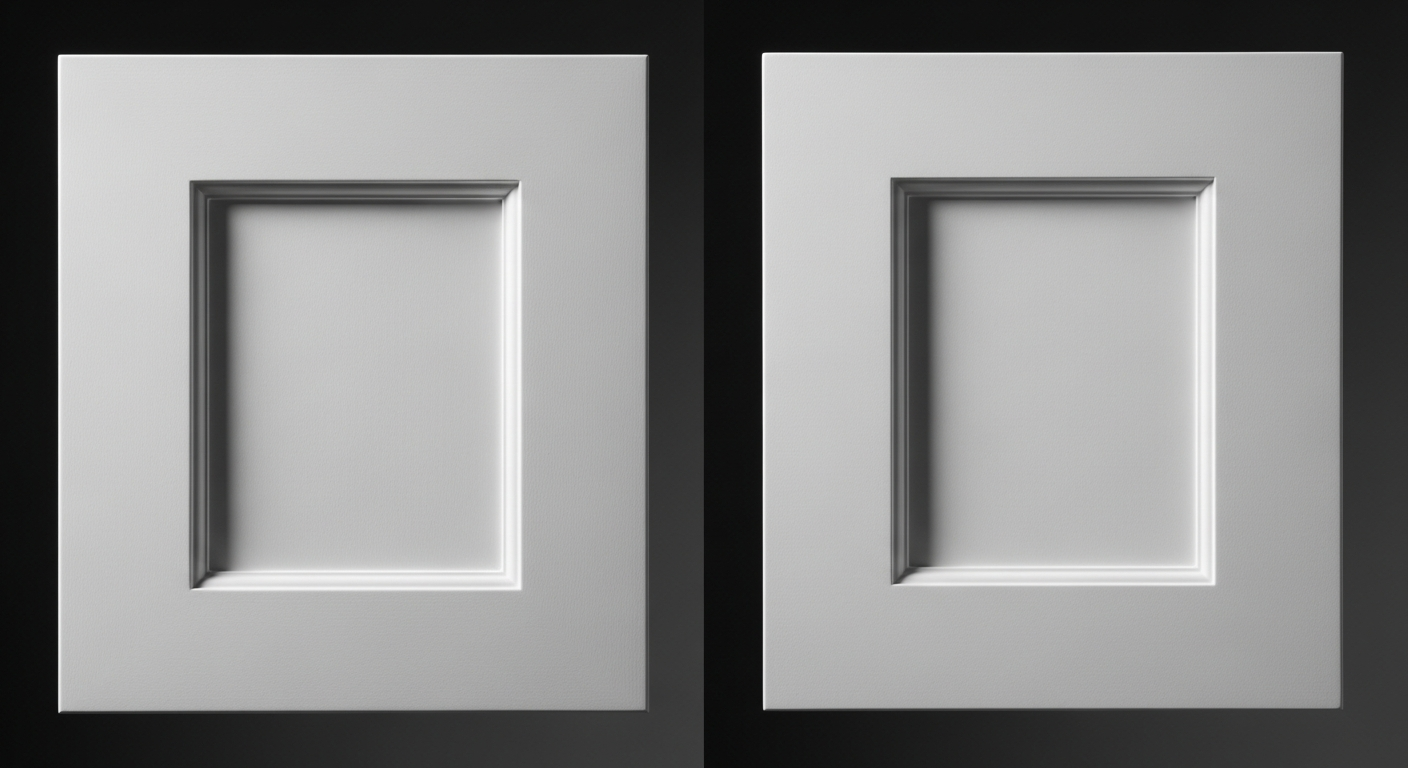
If you ask ten kitchen designers to name the two most common cabinet door styles in current renovation work, nine will say shaker and flat panel. Together these two profiles dominate kitchen design across Westchester and most of the Northeast — and for good reason. Both are clean, versatile, and hold their visual relevance over time in a way that more ornate styles do not.
Choosing between them is not a question of quality — both are available at every quality tier, from stock to custom. It is a question of design vocabulary: which profile is appropriate for your home's architecture, your lifestyle, and the aesthetic direction you want the kitchen to take.
Understanding the Shaker Profile
The shaker door is defined by its frame-and-panel construction: a flat center panel surrounded by four square-edged rails and stiles. The result is a subtle shadow line at the transition between frame and panel — a three-dimensional quality that adds depth without ornamentation. This profile originated with the Shaker religious community in 18th-century America, whose furniture philosophy valued function, quality construction, and unadorned design.
What makes shaker so enduring is its geometric neutrality. The profile is simple enough that it does not impose a strong stylistic identity on the kitchen — it reads as traditional in a painted white finish with antique brass hardware, as craftsman in a stained oak, and as contemporary in a two-tone kitchen with flat black hardware. This range of compatibility is why shaker has remained the predominant cabinet style in American kitchen renovation for decades.
Shaker cabinets have one maintenance consideration relative to flat panel: the inside corner of the frame-and-panel joint can accumulate grease and grime in a busy kitchen. This is not difficult to clean with a cloth or brush, but it requires attention that a flat surface does not.
Understanding the Flat Panel Profile
Flat panel doors (also called slab doors) are exactly what the name describes: a single flat surface with no frame, profile cuts, or recessed panel. The absence of all ornamentation is itself a design statement — one aligned with modernist and Scandinavian design principles where material quality and proportion carry the aesthetic rather than surface detail.
The simplicity of flat panel construction places higher demands on material and finish quality. There are no profile shadows or textural details to draw the eye or forgive inconsistencies in the surface. A flat panel door in a high-gloss lacquer finish reveals every fingerprint, and any imperfection in the spray application is visible under raking light. A flat panel door in a matte finish is more forgiving. This is why flat panel cabinetry is most commonly specified in painted matte or satin finishes, or in wood veneer with a visible grain direction.
Flat panel is the easiest cabinet surface to clean — a flat cloth wipe removes everything without navigating corners or crevices. This practical advantage is meaningful in a high-use household kitchen.
Architectural Fit: Which Style Belongs in Which Home
This is the most important question for homeowners in Westchester's older housing stock. Most homes built before 1970 have an architectural vocabulary — exterior trim profiles, interior millwork proportions, window and door casings — that is more sympathetic to shaker than to flat panel. A 1920s Tudor with decorative barge boards and divided-light windows will feel more coherent with a shaker kitchen than a completely frameless flat-panel one.
That said, many homeowners successfully install contemporary flat-panel kitchens in traditional homes by treating the kitchen as a deliberate design departure from the rest of the house — a modern renovation that does not pretend to be original to the building. This approach works when executed with commitment. What does not work is an attempt at a hybrid that is neither fully contemporary nor authentically traditional: flat-panel doors with traditional crown moulding corbels, or shaker doors with ultra-contemporary handle-less push-to-open hardware.
For homes built after 1990 — particularly open-plan layouts and modern new construction — flat panel is frequently the more natural choice. Its clean geometry suits the proportional vocabulary of contemporary architecture.
Hardware Considerations for Each Style
Hardware choices read very differently on shaker versus flat-panel cabinets. Shaker doors are visually complete with pulls or without them: the profile shadow lines provide a visual reference point even on unpulled cabinets. Flat panel doors that are not handle-less (integrated J-pull or push-to-open) require hardware that is proportionally considered — the pull becomes the only visual element on an otherwise blank surface.
For shaker kitchens: bar pulls, cup pulls, and bin pulls are all traditional options. Knobs work on smaller cabinet doors and drawers. For flat-panel contemporary kitchens: integrated J-channel pulls (routed into the top of the door or bottom of the upper cabinet) or push-to-open mechanisms maintain the visual purity of the slab surface. When visible hardware is used on flat-panel, it typically has a more minimal profile than the pulls used on shaker.
Cost Comparison
At comparable quality levels, shaker and flat-panel doors are typically priced within 5 to 10 percent of each other — the frame-and-panel construction of shaker versus the precision material requirements of flat panel roughly balance out. The cost differential becomes more pronounced at the extremes: high-gloss flat-panel lacquer cabinets (which require multiple spray coats, extensive sanding, and a perfectly prepared surface) cost more than painted shaker at the same quality tier. Custom inset shaker cabinetry costs more than frameless flat panel at the same width and height due to the tighter manufacturing tolerances required.
Ready to Start Planning?
Talk to the Three Brothers Team
We've completed hundreds of kitchen and bathroom renovations across Westchester County since 1979. Visit our Chappaqua showroom or call to discuss your project.
Frequently Asked Questions
Which cabinet style is more popular right now — shaker or flat panel?
Shaker remains the most widely specified door style overall in American kitchen renovation. Flat panel has been gaining ground in contemporary and modern new construction and is now the dominant style in recently built homes. In Westchester's older housing stock — Colonials, Tudors, and mid-century homes — shaker continues to be specified in the large majority of renovations.
Does shaker or flat panel hold its value better?
Both styles have proven staying power compared to more ornate traditional profiles that have dated significantly. Shaker's broad compatibility across styles gives it broad resale appeal. Flat panel's association with contemporary design suits current buyer preferences in new construction. Neither is a risky choice for resale.
Is flat panel harder to keep clean than shaker?
The opposite is true. Flat panel has no interior corners or crevices, making it the easiest cabinet surface to wipe clean. Shaker's frame-and-panel joint accumulates grease over time in kitchen use and requires more thorough cleaning. The maintenance difference is minor but real.
Can I mix shaker and flat panel in the same kitchen?
Mixing styles within the same kitchen is generally not recommended because it creates visual incoherence. A common design approach is to use one door style throughout and create variation through color (two-tone lower and upper cabinets) or material contrast (a different finish on the island versus perimeter). If your design team recommends mixing styles, ask them to show you a rendered example before committing.
What paint colors work best with shaker cabinets?
Shaker cabinets are among the most paint-color-compatible door profiles available. Popular choices in Westchester kitchens include warm whites (Benjamin Moore White Dove, Chantilly Lace), soft grays (Repose Gray, Agreeable Gray), navy (Hale Navy, Newburyport Blue), and forest green (Roycroft Bottle Green, Sheraton Sage). Two-tone combinations — white uppers with a deeper shade on lowers — are extremely common.
Do flat panel cabinets look too modern for an older home?
Not necessarily — it depends on execution. A flat-panel kitchen in a traditional home works when it is designed with enough commitment to the contemporary direction to feel intentional. Matte or natural finishes are more sympathetic to older homes than high-gloss lacquer. If the kitchen opens to traditionally finished adjacent rooms, the contrast requires careful design management.
What hardware finish is most popular in current kitchen renovations?
Matte black and brushed brass are the two most specified hardware finishes in Westchester kitchen renovations currently. Satin nickel and polished chrome, which dominated for many years, have declined as primary choices but remain appropriate for transitional kitchens. Aged bronze and unlacquered brass are gaining popularity in craftsman and farmhouse settings.