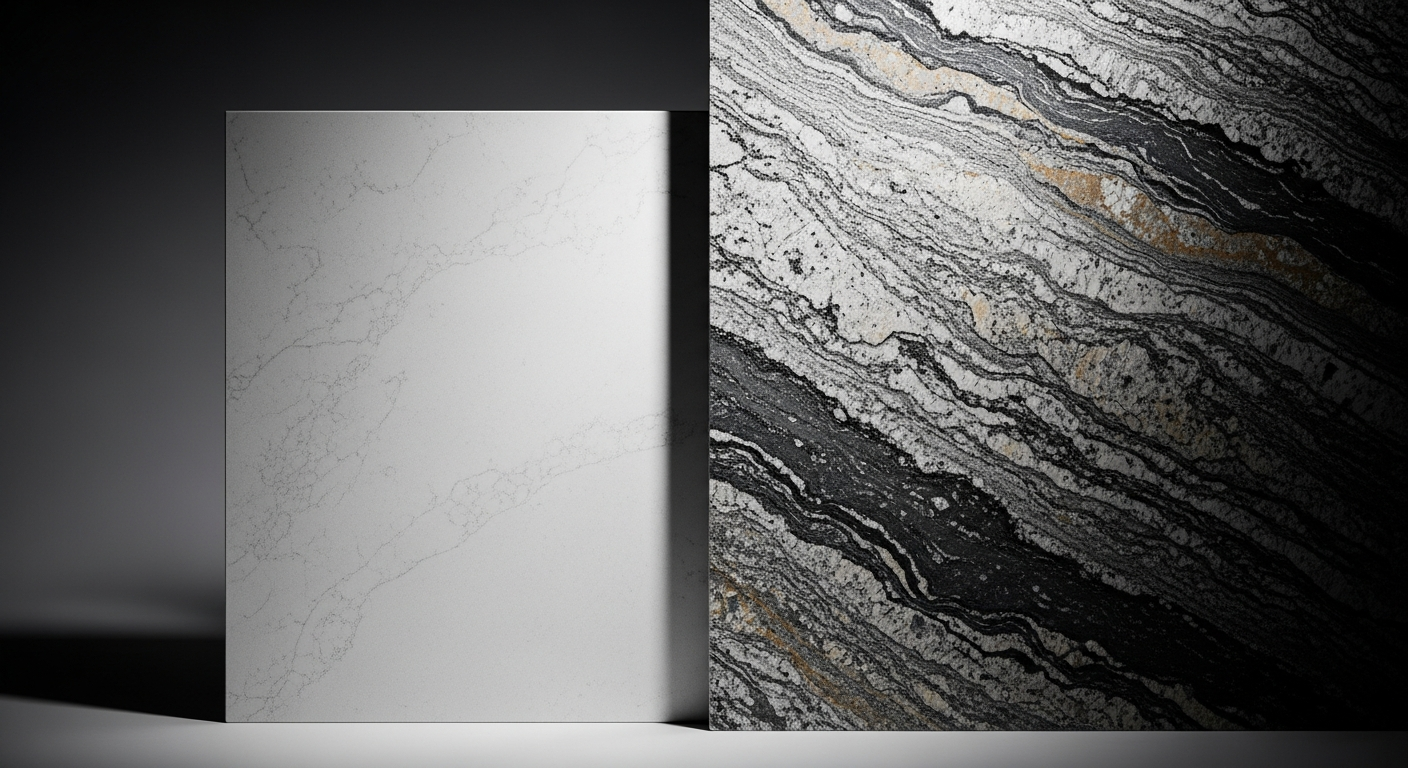
Quartz versus granite is the most common countertop question in kitchen renovation, and it has been for nearly two decades. Both materials are widely available, both look excellent in kitchen applications, and both are available at broadly similar price ranges. The decision between them comes down to a small number of specific trade-offs that are genuinely important to understand before you commit.
This guide evaluates both materials on the dimensions that matter over 15 to 20 years of daily kitchen use — not just how they look in a showroom or a design magazine photograph.
What Quartz and Granite Actually Are
This distinction matters more than many homeowners realize. Granite is a natural igneous stone quarried from geological formations, cut into slabs, and polished. Every granite slab is unique in its pattern, coloring, and mineral composition. The variation between slabs of the same quarry designation can be significant — when specifying granite, your installer will show you the actual slabs you will receive, not a generic sample.
Quartz countertops (brands: Cambria, Silestone, Caesarstone, and many others) are manufactured products. They consist of 93 to 95 percent crushed natural quartz aggregate mixed with polymer resins and pigments, then formed under heat and pressure. This manufacturing process produces a non-porous surface with consistent, repeatable appearance. Quartz can closely mimic granite and marble patterns, but it does so through a manufacturing process rather than through natural geological variation.
Maintenance: The Most Important Practical Difference
This is the dimension where quartz and granite differ most significantly. Granite is a porous natural stone: it absorbs liquids at a microscopic level and requires periodic sealing to prevent staining. The sealing frequency depends on the specific granite variety and how heavily the kitchen is used — typically once a year for kitchen applications. A properly sealed granite countertop performs very well. When sealing is deferred or forgotten, the stone becomes progressively more vulnerable to staining from oils, wine, coffee, and acidic foods.
Quartz requires no sealing, ever. Its non-porous surface resists staining from virtually all household substances and requires nothing beyond soap and water for daily cleaning. For households with demanding schedules, young children, or homeowners who simply do not want to maintain a kitchen surface on an annual schedule, this practical advantage is decisive.
A note on heat resistance: both granite and quartz can tolerate moderate heat, but sudden thermal shock — placing a very hot pan directly from the oven onto the surface — can crack either material. Use trivets with both.
Appearance: Natural Character vs. Manufactured Consistency
This is where personal preference rightly dominates. Granite's natural variation — the way mineral deposits create movement, depth, and unique patterning in each slab — is something that engineered stone cannot fully replicate. When a granite slab has strong natural character, it becomes an aesthetic feature of the kitchen that feels alive and particular to that room.
Quartz offers visual consistency. The pattern on a quartz countertop is the same from one end of the kitchen to the other, and the material you specified is the material you receive — there are no slab-to-slab variations. This consistency is a feature for some homeowners and a limitation for others. Quartz's marble-look products have become visually very convincing, but the pattern repeat — the point at which the manufactured pattern begins to repeat — is detectable in kitchens with long runs of countertop.
In terms of available aesthetics: granite offers a wider range of genuine natural variation but requires slab selection. Quartz offers a broader range of consistent colors and pattern types, including solid colors, concrete looks, and stone-look patterns not available in natural stone.
Durability and Long-Term Performance
Both materials are highly durable under normal household use. Granite scores higher on the Mohs hardness scale (6 to 7) compared to quartz countertops (typically around 7 for the quartz aggregate, moderated by the resin binder). Both resist scratching from normal kitchen use — cutting directly on either surface is not recommended both to protect the surface and to preserve knife edges.
Granite can chip at edges and corners if struck with sufficient force; chips can typically be repaired by a stone professional. Quartz edge chips are more difficult to repair invisibly because the engineered coloring may not match the factory finish. Both materials can crack under severe impact or thermal shock.
Cost Comparison in Westchester
Granite and quartz are broadly comparable in installed cost, though the ranges overlap rather than align precisely. Granite typically runs $60 to $130 per square foot installed, with pricing determined by slab origin (domestic vs. imported), rarity of the pattern, and thickness. Quartz runs $70 to $150 per square foot installed, with pricing determined by brand, pattern complexity, and thickness.
The countertop material cost in any kitchen renovation is often smaller than homeowners expect relative to the total project budget. In a typical full kitchen renovation, countertops represent 10 to 15 percent of the total project cost. The difference between granite and quartz at comparable quality levels rarely changes the overall project budget significantly.
Which Material Is Right for Your Kitchen?
Choose quartz if: you prioritize low maintenance and do not want to think about sealing; you have children in the household who will use the countertop as a work surface; you want consistent, predictable appearance; or you are renovating a bathroom vanity where water exposure is constant and maintenance schedules are easily forgotten.
Choose granite if: you value natural material character and the visual uniqueness of each slab; you are willing to commit to annual sealing; you enjoy the process of selecting the specific slab that will go into your kitchen; or you are designing a kitchen where the natural stone is intended to be a design centerpiece.
For many Westchester homeowners designing high-end kitchen renovations, the choice comes down to this: quartz for households that use their kitchens heavily and want low-maintenance performance; granite (or quartzite or marble) for households that appreciate the investment in natural material and are prepared to maintain it.
Ready to Start Planning?
Talk to the Three Brothers Team
We've completed hundreds of kitchen and bathroom renovations across Westchester County since 1979. Visit our Chappaqua showroom or call to discuss your project.
Frequently Asked Questions
Is quartz or granite more expensive?
Both materials are broadly comparable in installed cost. Quartz typically runs $70 to $150 per square foot installed; granite runs $60 to $130 per square foot. Premium granite slabs with unusual patterning can exceed quartz pricing significantly.
Which is harder — quartz or granite?
Both are very hard materials. Natural granite measures 6 to 7 on the Mohs hardness scale. Quartz aggregate measures around 7, though the polymer resin binder in engineered quartz moderates the overall hardness. Both surfaces resist scratching from normal kitchen use.
Does granite really need to be sealed every year?
Most granite varieties benefit from annual sealing in kitchen applications. The actual frequency depends on the porosity of the specific granite — some denser granites require less frequent sealing. A simple water test (place a drop of water on the stone: if it beads for 10+ minutes, the seal is intact; if it absorbs within a few minutes, it's time to reseal) will tell you where your stone stands.
Can you set hot pans on granite or quartz?
Both materials can tolerate moderate heat. However, sudden extreme heat — a cast iron pan coming directly from a 500°F oven — can cause cracking or discoloration in either material. Using trivets is the recommended practice with both granite and quartz.
Is quartz better than granite for resale value?
Both granite and quartz add comparable value to home resale. Quartz has slightly broader buyer appeal because of its low maintenance requirements. A granite kitchen with unusual or dramatic natural stone can be a design selling point in certain buyer profiles.
What is easier to clean — quartz or granite?
Quartz is easier to clean because it is non-porous: spills do not penetrate the surface and clean up with soap and water. Granite cleans easily when properly sealed but is more vulnerable to staining if the seal has degraded.
Can quartz look like granite or marble?
Yes — engineered quartz is available in designs that closely mimic granite and marble. The visual accuracy has improved dramatically over the past decade. The difference becomes more detectable in very large installations where the pattern repeat in manufactured stone is visible.