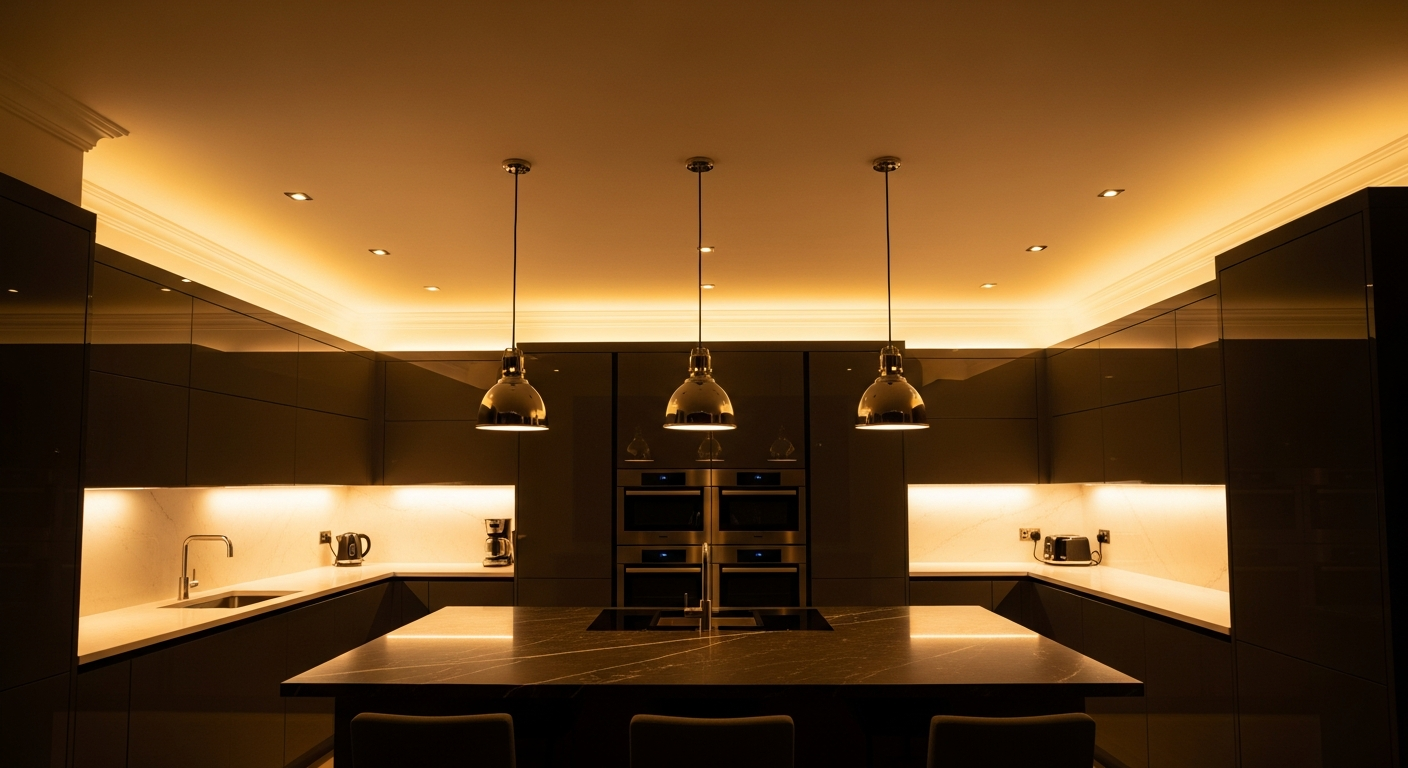
Kitchen lighting is one of the most consistently underplanned elements in home renovation. Homeowners invest substantial thought and budget into cabinetry, countertops, and appliances — all of which are selected months before construction — but lighting often gets minimal attention until the electrician asks where to put the recessed lights.
This matters for a practical reason: lighting placement is roughed into the walls during the electrical phase of construction, before drywall is installed. Changes after the fact require opening finished walls. The time to plan lighting thoroughly is before construction begins — not after.
The Three-Layer Lighting Model
Kitchen lighting design is most effectively approached as three distinct layers, each serving a different function. Understanding the layers first, then specifying the fixtures that deliver each layer, produces a kitchen that works well at every time of day and for every task.
Ambient lighting provides the general illumination level of the kitchen — sufficient light to navigate the space safely and see what you are doing at a basic level. Task lighting delivers focused light specifically to the work surfaces where food preparation happens. Accent lighting creates depth, warmth, and visual interest beyond pure function. Most kitchen lighting problems — spaces that feel too dark, too bright, too flat, or too harsh — are the result of specifying only one or two of these layers rather than all three.
Ambient Lighting: Recessed Downlights Done Right
Recessed downlights (can lights) are the most common ambient lighting source in kitchen renovation. The placement of recessed lights has a significant effect on both their function and the room's appearance. The most common mistake is placing them in a regular grid pattern, centered in the room, without reference to the cabinet and countertop layout beneath them. This approach typically results in light that illuminates the floor and the tops of countertops adequately but leaves the primary work zone — the surface 18 inches below the upper cabinet — in shadow.
A better approach: locate ambient downlights 24 to 30 inches in from the wall (measured to the center of the light), which places them over the front of the base cabinets and the countertop work zone rather than over the floor area. This position casts light onto the work surface rather than past it. Space lights 4 to 6 feet on center in each direction, adjusted as necessary for ceiling features or cabinet soffits.
For kitchens with 8-foot ceilings, 3-inch and 4-inch LED downlights are proportionally appropriate. For higher ceilings (9 feet and above), 4-inch and 6-inch downlights read better. All recessed lighting should be on dimmer circuits.
Task Lighting: Undercabinet as Non-Negotiable
LED undercabinet task lighting is the single highest-value lighting addition in a kitchen renovation relative to its cost. Undercabinet strips are mounted to the underside of the upper cabinet, directed at the countertop work surface directly below — exactly where food is prepared. Without undercabinet lighting, the cook stands in their own shadow cast by the upper cabinet overhang above the work zone.
Current undercabinet options include puck lights (point sources, now less common), linear LED strip lights (continuous illumination across the entire countertop length, the preferred option), and LED light bars (fixtures that mount in a channel beneath the cabinet). For a continuous, even wash of light across the countertop without harsh shadows or visible light sources, LED strip lights in a channel recessed into the cabinet bottom are the cleanest installation.
Undercabinet lighting should be on a separate switch from the ambient overhead lights and ideally on a dimmer. This allows the undercabinet lights to be used independently during evening counter use without illuminating the full kitchen at high ambient levels.
Pendants Over Islands and Peninsulas
Pendant lights over a kitchen island or peninsula serve both task and accent functions simultaneously. They direct focused light onto the island work surface (task function) while also creating a visual anchor for the island that relates it to the ceiling plane (design function).
Pendant placement rules: hang pendants so that the bottom of the fixture is 30 to 36 inches above the countertop surface. For a standard 9-foot ceiling and 36-inch countertop height, this places the pendant bottom at approximately 66 to 72 inches above the floor. Space multiple pendants evenly: two pendants over a 48-inch island, three over a 72-inch island. The pendant diameter should be proportional to the island width — a single large pendant (18 to 24 inches) over a 48-inch island; three smaller pendants (8 to 12 inches each) over a 72-inch island.
Pendant style should be consistent with the overall kitchen aesthetic. In a contemporary kitchen with flat-panel cabinetry, a pendant with exposed bulb and minimal metal detailing reads correctly. In a transitional shaker kitchen, a lantern-form or drum pendant in a brushed metal finish is more sympathetic.
Accent Lighting: Depth and Warmth
The accent lighting layer is what separates a kitchen that looks good in photographs from one that feels genuinely pleasant to be in at every time of day. Accent lighting sources in a kitchen include: LED strip lighting inside glass-front upper cabinets (illuminating dishware or objects on display), toe kick lighting (LED strips mounted at the base of the cabinet toe kick, creating a warm glow that makes the cabinet appear to float), above-cabinet lighting (strip lights mounted on top of upper cabinets that wash light up toward the ceiling, creating indirect ambient warmth), and decorative pendants or sconces.
None of these accent lighting elements is required. Any one of them, added to a kitchen that already has adequate ambient and task lighting, transforms the nighttime experience of the space significantly. The investment is modest; the daily quality-of-life improvement is real.
Color Temperature: The Often-Forgotten Variable
Color temperature, measured in Kelvin, determines whether a light source appears warm (yellowish) or cool (blue-white). The most common mistake in kitchen lighting is mixing color temperatures — installing warm LED downlights (2700K) alongside cooler undercabinet lighting (4000K). The result is a kitchen where different surfaces appear to be lit by different types of light, creating visual incoherence.
For kitchen applications, 2700K to 3000K produces a warm, residential quality of light that is flattering to food and materials. 3500K to 4000K produces a crisper, brighter light appropriate for task-critical areas. The recommendation for residential kitchens: specify all lighting at 2700K to 3000K for a cohesive, warm result. If the kitchen also serves as a workspace where precise color rendering matters, 3000K provides a good balance. Avoid mixing temperatures within the same space.
Ready to Start Planning?
Talk to the Three Brothers Team
We've completed hundreds of kitchen and bathroom renovations across Westchester County since 1979. Visit our Chappaqua showroom or call to discuss your project.
Frequently Asked Questions
How many recessed lights do I need in my kitchen?
A general rule is one 4-inch recessed light per 4 to 6 square feet of kitchen floor area, adjusted for ceiling height (taller ceilings require more wattage or closer spacing) and the presence of undercabinet task lighting (which reduces the ambient lighting demand). A 200 square foot kitchen typically uses 8 to 12 recessed downlights, depending on layout.
Should all kitchen lights be on dimmers?
Yes — all kitchen lighting circuits benefit from dimmer control. Full-brightness kitchen lighting is appropriate for meal preparation; lower ambient lighting is appropriate for dining at a kitchen table, late-evening snacks, and other non-preparation activities. Dimming also reduces energy consumption and extends lamp life significantly.
What color temperature should kitchen lights be?
2700K to 3000K is the recommended range for residential kitchens. This produces a warm, flattering light that is appealing for both cooking and dining. Most importantly, maintain a consistent color temperature across all light sources in the kitchen — mixing warm and cool temperatures in the same space creates visual incoherence.
Where should recessed lights be placed in a kitchen?
Position ambient recessed lights 24 to 30 inches from the wall (center of fixture to wall face), which places them over the countertop work zone rather than the floor. Space them 4 to 6 feet on center in each direction. Avoid placing lights directly over the edge of upper cabinets, where they will create harsh shadows on the countertop below.
What is the best undercabinet lighting option?
LED strip lights in a recessed channel along the bottom of the upper cabinet provide the most even, shadow-free illumination of the countertop work zone. They should span the full length of the upper cabinet run rather than ending at intervals. Separate switches and dimmer controls allow undercabinet lights to be used independently of overhead fixtures.
How high should pendant lights hang over an island?
The bottom of the pendant should be 30 to 36 inches above the countertop surface. For a standard 36-inch island counter, this places the pendant bottom approximately 66 to 72 inches above the floor. In kitchens with very high ceilings, this measurement remains consistent — the pendant chain or rod should be extended accordingly to maintain proper working height.
Do I need natural light in a kitchen?
Natural light in a kitchen improves both the practical experience of food preparation and the perceived quality of the space significantly. When planning a kitchen renovation, maximize window area where possible, and consider a window over the sink as a priority (the position where the most time is spent with eyes looking at one spot). Skylights are an excellent addition for dark kitchens where wall windows are limited by adjacent structure.