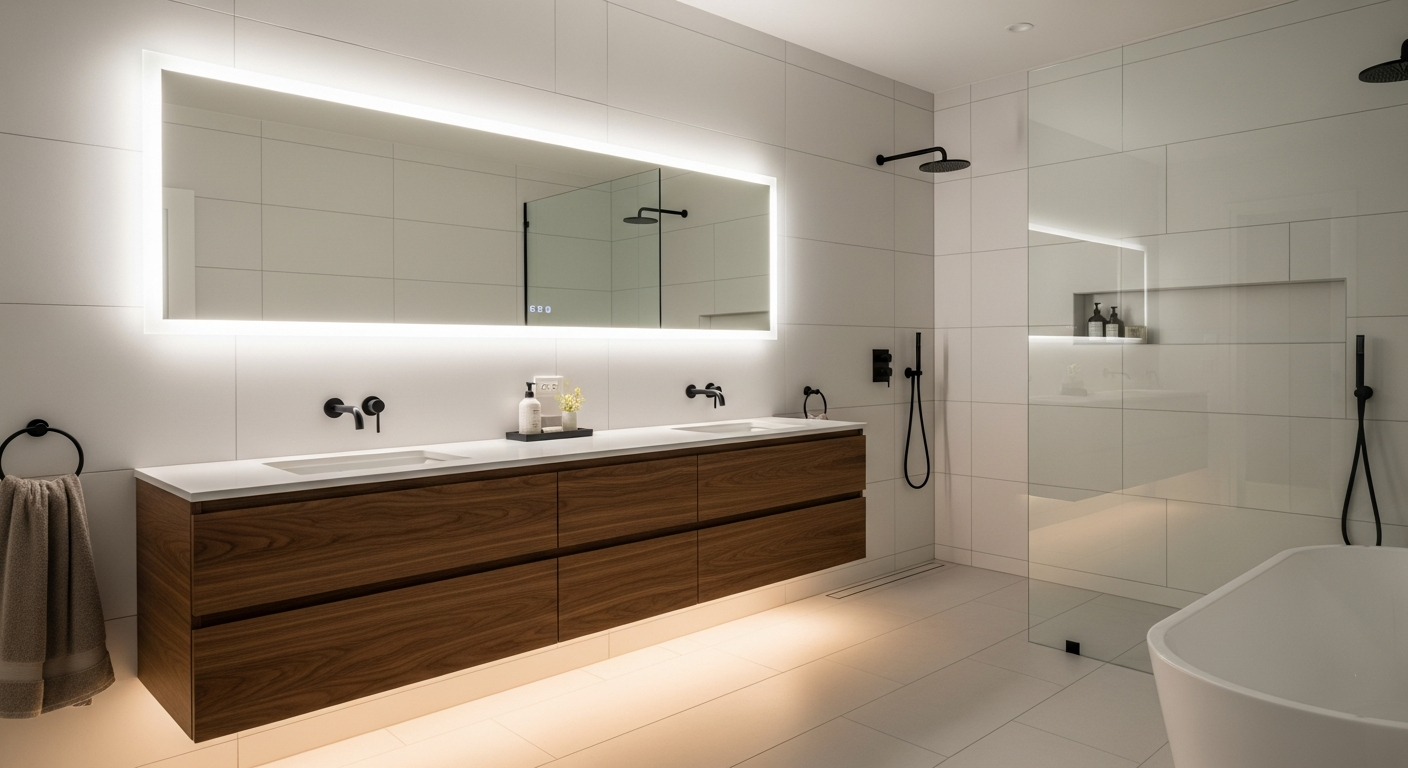
The word 'modern' is applied to bathroom design so broadly that it has become nearly meaningless as a descriptor. In home renovation, it can refer to anything from a bathroom with a vessel sink to a fully architect-designed spa room with integrated technology. This guide uses the term precisely: modern bathroom design refers to spaces that apply modernist design principles — clean geometry, material honesty, visual restraint, and functional clarity — to a bathroom context.
Designing a bathroom that feels contemporary today and remains appealing fifteen years from now requires distinguishing between design principles (which endure) and trend-driven details (which cycle). This guide focuses on the former.
The Core Principle: Visual Simplicity Through Material Quality
In traditional bathroom design, visual interest comes from ornamentation: profile cuts on vanity doors, decorative hardware, patterned tile borders, and layered accessories. In modern bathroom design, visual interest comes from material quality and proportion. A floating walnut vanity against a large-format white tile wall is visually rich not because of its ornamental detail but because of the contrast in material character — warm wood grain against smooth, cool stone-look tile.
This shift in how visual interest is created has a practical implication: material quality matters more in a modern bathroom than in a traditional one. In a traditional bathroom, a slightly imperfect grout joint is hidden by the visual complexity of the surrounding design. In a modern bathroom with large-format tile and minimal ornamentation, execution quality is immediately visible. This is one reason modern bathroom renovation typically requires more skilled installation than traditional bathroom work.
Floating Vanities: The Signature Modern Element
The floating (wall-mounted) vanity — mounted to the wall with concealed brackets, leaving the floor beneath it visible — is the single most recognizable element of modern bathroom design. It creates a visual floating effect that makes the floor appear to extend uninterrupted, creating a sense of openness that floor-mounted vanities cannot achieve.
From a practical standpoint, a floating vanity also makes cleaning the floor significantly easier: there are no legs, no floor base, and no frame to clean around or under. The clearance between the bottom of the vanity and the floor (typically 6 to 12 inches) also allows for recessed lighting beneath the vanity — an accent lighting element that contributes to the warm, layered lighting that modern bathrooms require.
Floating vanities are available in a wide range of configurations, from single-sink units in smaller bathrooms to 72-inch double vanities in primary suites. Current materials for floating vanity fronts include lacquered MDF (high-gloss or matte), natural wood veneer (white oak is currently the most popular in Westchester renovations), and solid wood in painted or stained finishes.
Large-Format Tile: Fewer Joints, More Impact
Large-format tile — 24x24 inches and larger, with some installations using 48x96 inch porcelain slabs — has replaced the 12x12 inch and smaller tiles that dominated bathroom design through the 1990s and 2000s. The primary visual effect of large-format tile is a reduction in grout joints: fewer visible seams creates a cleaner, more expansive appearance.
Large-format tile also has a practical cleaning advantage: there is simply less grout surface to maintain. Grout is the most maintenance-demanding element in any tiled bathroom; reducing its total surface area reduces long-term cleaning work.
On shower floors, where slip resistance is required, large-format tile is not appropriate. The shower floor should use smaller mosaic tile (2x2 or similar), which provides the drainage pitch control and texture that safety requires. This contrast between large-format wall tile and mosaic floor tile in a shower is itself a modern design detail — intentional material differentiation rather than uniform coverage.
Frameless Glass Enclosures
The frameless glass shower enclosure — made from 3/8 or 1/2 inch tempered glass with minimal metal hardware at the door pivot and fixed panel — is standard in contemporary bathroom design. It allows the tile work inside the shower to be fully visible from the bathroom, making the shower feel larger and the entire bathroom more open.
The alternative — the semi-frameless or framed shower enclosure with aluminum channels at the top and sides — collects soap scum, mold, and mineral deposits in its metal frame that are difficult to clean thoroughly. Frameless enclosures have no top or side channels; cleaning is simply a matter of wiping the glass. The higher upfront cost of frameless versus framed glass is recovered in reduced maintenance over time.
Lighting in Modern Bathrooms
Modern bathroom lighting design operates on three layers. Ambient light — typically recessed downlights in a grid pattern — provides general illumination sufficient for safe navigation. Task light at the vanity — ideally side-mounted fixtures at eye level on either side of the mirror, or a horizontal LED fixture mounted directly above the mirror — eliminates the unflattering shadows created by overhead-only lighting.
The third layer is accent lighting: LED strips mounted under a floating vanity, behind a backlit mirror, or along the perimeter of a feature wall. This lighting layer is what gives a modern bathroom its warm, dimensional quality at night — the kind of bathroom that feels spa-like rather than purely functional. Dimmer switches on all circuits are non-negotiable in a properly designed modern bathroom.
Material Combinations That Work
The most successful modern bathroom material palettes pair no more than three primary materials, with clear intentionality in how they are combined. Current material combinations that work well in Westchester bathrooms: white large-format porcelain tile with natural white oak floating vanity and matte black hardware; warm gray stone-look tile with painted white vanity and brushed brass fixtures; concrete-look tile with walnut vanity and polished chrome hardware.
The combination rule for modern bathrooms: one dominant material (usually tile, which covers the largest surface area), one contrasting material (vanity, which introduces a different texture and color), and one accent material (hardware and fixtures, which appear in small quantities but read as a unifying detail throughout the space).
Ready to Start Planning?
Talk to the Three Brothers Team
We've completed hundreds of kitchen and bathroom renovations across Westchester County since 1979. Visit our Chappaqua showroom or call to discuss your project.
Frequently Asked Questions
What defines a modern bathroom style?
Modern bathroom design is characterized by clean geometry, minimal ornamentation, material quality as the primary source of visual interest, and functional clarity. Signature elements include floating vanities, large-format tile with minimal grout joints, frameless glass enclosures, and layered lighting with dimmer controls.
What is the most popular bathroom tile size in 2026?
Large-format tile in the 24x24 to 48x48 inch range is the current standard in contemporary bathroom renovation. Porcelain slabs (48x96 inches or larger) are increasingly used in high-end primary bathrooms. On shower floors, 2x2 inch mosaic tile remains appropriate for drainage pitch and slip resistance.
How do I choose a vanity for a modern bathroom?
Floating (wall-mounted) vanities are the signature element of modern bathroom design. Current material choices include natural wood veneer (white oak is most popular), high-gloss or matte lacquered MDF, and painted wood. Consider the vanity depth relative to the available floor space — 18 to 21 inches is standard for smaller bathrooms; 21 to 24 inches is more comfortable in larger spaces.
What hardware finish is most popular in modern bathrooms?
Matte black is the most popular hardware finish in modern and contemporary bathroom renovations currently. Brushed brass is close behind and is the warmer-toned alternative that works well with wood vanities and warmer tile palettes. Polished chrome remains appropriate in cleaner, cooler color palettes.
What makes a bathroom feel spa-like?
Heated tile floors, a large rain shower head, a soaking tub (in a primary suite with adequate space), layered lighting with dimmer controls, natural material elements (wood, stone, or textured tile), and minimal visual clutter. Sound attenuation — a bathroom that feels acoustically quiet — is also a feature of high-end spa bathrooms that is achieved through insulation in the walls and quality doors.
What is the difference between modern and contemporary bathroom design?
In design terminology, 'modern' refers to the early-to-mid 20th century modernist movement — clean lines, minimal ornamentation, industrial materials. 'Contemporary' describes current design trends, which often blend modern principles with warmer materials and natural elements. In practice, the terms are used interchangeably in home renovation contexts. The design principles described in this guide apply to both.
Do modern bathrooms go out of style?
Bathrooms designed around fundamental modernist principles — material quality, geometric simplicity, restrained ornamentation — hold up over time better than those driven by trend-specific details. A well-proportioned white tile bathroom with a quality vanity and frameless glass has remained appealing through multiple trend cycles. The details that date fastest are very specific color choices and highly trend-specific hardware — which are also the easiest to update without renovation.