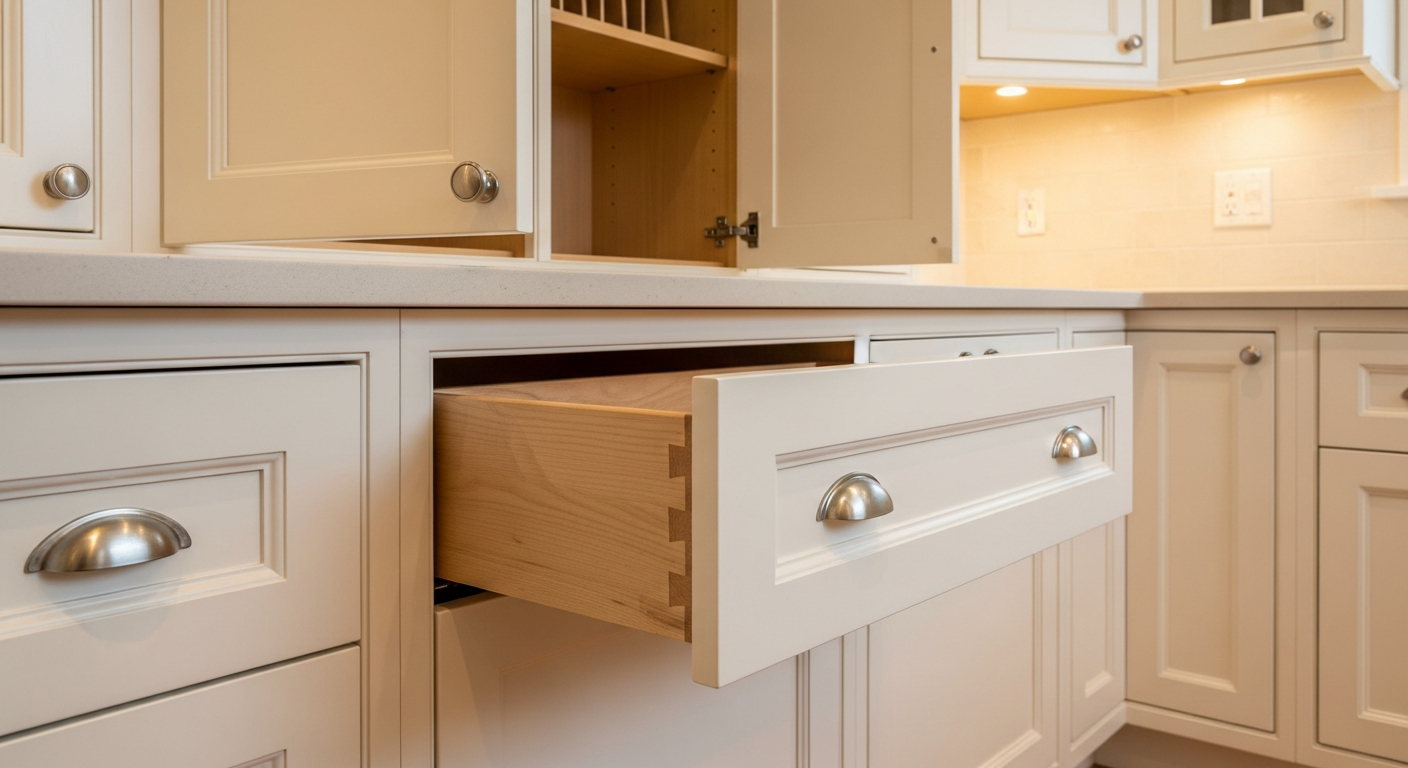
The terms 'stock,' 'semi-custom,' and 'custom' are used consistently in the cabinetry industry, but their meaning is not always clearly explained to homeowners during the renovation process. Understanding what each tier actually provides — not just in marketing terms, but in terms of what ends up in your kitchen — is essential to making an informed investment.
The decision between cabinet tiers affects not only aesthetics but practical functionality: how well the cabinets fit your space, how many storage configuration options are available, how long installation takes, and how the cabinetry holds up over a decade of daily use.
Stock Cabinets: The Builder's Grade Baseline
Stock cabinets are mass-produced in standard dimensions — typically in 3-inch increments — and stocked in warehouse inventory for immediate availability. This production model creates its primary advantages: low cost and quick availability. A homeowner who selects stock cabinets from a big-box retailer can often have them in hand within days to weeks.
The limitations of stock cabinetry are significant in non-standard kitchen layouts. Because stock cabinets come in fixed widths, fitting them into a kitchen often requires filler strips — strips of wood used to fill the gap between a cabinet end and a wall or adjacent cabinet. In a kitchen where the dimensions do not align with standard cabinet widths, filler strips can accumulate throughout the layout, creating an appearance that reads as builder-grade regardless of what door style is chosen.
Stock cabinet construction typically uses particleboard boxes with thinner plywood backs — adequate for dry storage but less durable in moisture-prone areas around dishwashers, sinks, and exterior walls. Interior organization options are limited compared to higher tiers. For budget-focused renovations where the primary goal is an updated appearance within a simple rectangular layout, stock cabinetry can deliver adequate results.
Semi-Custom Cabinets: The Middle Tier Most Westchester Homeowners Choose
Semi-custom cabinets are manufactured to order but within a defined range of sizes, finishes, and configurations offered by each manufacturer. Sizing increments are narrower than stock — typically 1.5 inches rather than 3 inches — which means semi-custom cabinets can fill a kitchen layout with far fewer filler strips and a better overall fit.
The configuration options available in semi-custom dramatically exceed stock: pull-out shelves, drawer inserts, specialized storage accessories, corner solutions, and custom height options are all available through semi-custom manufacturers. The finish selection is broader, door style options are more numerous, and interior box construction is typically better than stock — usually plywood boxes at mid-to-high-end semi-custom price points.
Lead time for semi-custom cabinets is typically 4 to 8 weeks from order to delivery. For most kitchen renovation timelines, this is manageable when ordered at the beginning of the permit process. Semi-custom represents the quality tier where most Westchester kitchen renovations — particularly those in the $75,000 to $175,000 project budget range — are best served.
Full Custom Cabinets: When the Space or Design Demands It
Full custom cabinetry is built to exact specifications by a skilled cabinet shop — no standard dimensions, no preset configuration options, and no limitations on material, finish, or design detail. Every dimension is determined by the actual measurement of your specific kitchen. Custom allows for exact ceiling heights, unusual angles, arched openings, integrated appliance panels at precise dimensions, and any combination of door style and finish the designer specifies.
The advantages of full custom are most apparent in two situations: kitchens with non-standard dimensions or architectural features that stock and semi-custom cannot accommodate, and high-end kitchens where the cabinetry is intended to function as fine furniture. Inset cabinetry is frequently specified at the full custom level because the tight tolerances required for flush inset doors are most reliably achieved by custom cabinet shops.
The cost premium for full custom versus premium semi-custom is real but context-dependent. For a straightforward rectangular kitchen with standard ceiling heights, the incremental value of full custom over premium semi-custom may be difficult to justify. For a kitchen with unusual architectural conditions or design requirements that semi-custom cannot accommodate, the custom route is the appropriate choice.
How to Decide Which Tier Is Right for Your Project
The cabinet tier decision should be made in the context of the full project budget and the kitchen's layout complexity. In a simple rectangular kitchen, premium semi-custom cabinets can be installed with minimal filler and deliver exceptional results. In a kitchen with angled walls, ceiling soffits, or unusual heights, custom cabinetry pays for itself in a better-fitting result.
Interior organization accessories — pull-out shelves, drawer banks, specialty corner solutions — add significant functional value and are often available in semi-custom configurations at lower overall cost than adding them to a custom build. When evaluating proposals, compare not just the cabinet cost but the total delivered kitchen: cabinetry plus all the interior organization accessories that will make the kitchen function the way you need it to.
Ready to Start Planning?
Talk to the Three Brothers Team
We've completed hundreds of kitchen and bathroom renovations across Westchester County since 1979. Visit our Chappaqua showroom or call to discuss your project.
Frequently Asked Questions
Are custom cabinets worth the extra cost?
Custom cabinets are worth the cost when the kitchen has non-standard dimensions, unusual architectural features, or specific design requirements that semi-custom cannot meet. For kitchens with standard dimensions and straightforward layouts, premium semi-custom cabinets deliver excellent results at a lower overall cost.
How long do custom cabinets take to arrive?
Full custom cabinets typically have a lead time of 8 to 16 weeks from order confirmation, depending on the shop's current workload. Semi-custom cabinets typically arrive in 4 to 8 weeks. This timeline should be factored into the project schedule from the beginning — cabinet delivery often determines when installation can begin.
What is the box made of in quality cabinets?
Quality kitchen cabinet boxes are made of 3/4-inch plywood. Plywood is significantly more moisture-resistant than particleboard or MDF, holds screws more securely, and does not swell or delaminate when exposed to humidity. Particleboard boxes are common in stock cabinetry; plywood boxes are standard in mid-to-high-end semi-custom and custom cabinetry.
Can I mix stock and custom cabinets?
Technically yes, but it is rarely advisable. Differences in box depth, door thickness, face frame dimensions, and finish quality between manufacturers create installation challenges that typically cost more to address than they save. For any renovation where the goal is a cohesive, quality result, specifying all cabinetry from one manufacturer at one quality tier produces a better outcome.
What interior cabinet options are most worth the investment?
Pull-out shelf inserts in base cabinets, full-extension soft-close drawer glides, pull-out pantry columns, and a dedicated cutlery insert in at least one deep drawer consistently rank as the highest-value interior options in terms of daily usability. Under-sink pull-outs and trash/recycling pullouts are also practical additions that improve the kitchen's function without significant cost.
Is semi-custom the same thing at every cabinet brand?
No — the term 'semi-custom' covers a wide range of products from different manufacturers. Some semi-custom brands offer plywood boxes, wide finish selections, and extensive organization accessories; others offer only slightly more flexibility than stock. When comparing semi-custom proposals, ask specifically about box material, available sizing increments, and which interior accessories are included or available.